For heavy commercial vehicles, retro-reflective contour marking is not a choice but a requirement. The question is not whether you mark, but which marking your vehicle needs. That depends on three things: vehicle category, weight and dimensions.
The weight thresholds
The marking requirement starts at two clear thresholds:
- Goods vehicles over 7,500 kg, meaning category N2 above 7.5 tonnes and all N3.
- Trailers over 3,500 kg, meaning categories O3 and O4.
Lighter vehicles are outside the requirement. You may still mark them voluntarily with approved tape to improve visibility.
Dimensions decide the type
If your vehicle must be marked, its size determines which marking is needed:
- Rear: full contour marking when the vehicle is wider than 2,100 mm.
- Side: partial contour marking when the vehicle is longer than 6,000 mm.
Tractor units and cabs are generally outside the requirement. For bodies where the shape rules out contour marking, such as tankers, low loaders or car transporters, a line marking is accepted instead.
Who is responsible?
For new bodywork, correct marking sits with the bodybuilder and is considered in the approval. For conversions, repairs or curtain replacement, responsibility moves to the operator and the workshop. Damaged or missing marking can be a failure point at inspection.
Why it pays off
Contour marking is more than a formality. Its functional purpose is to help other road users recognise the size of a heavy vehicle in darkness. The cost of a complete set of tape is small against a single avoided collision.
Read the thresholds as one decision tree
The familiar thresholds come from the installation provisions in Regulation No. 48. At the rear, full contour marking applies to vehicles over 2,100 mm wide. At the side, partial contour marking applies above 6,000 mm in length; the drawbar is included for trailers. The categories are N2 over 7.5 tonnes, N3, O3 and O4. R48 also names exceptions, including chassis-cabs, incomplete vehicles and tractors for semi-trailers.
Do not check one weight or dimension in isolation. Record category, maximum mass, completion status, dimensions, first registration and country of registration. Transition provisions and the original type approval can matter for existing or converted vehicles.
Official sources
Check which marking your vehicle needs
Weight, length, width and body shape determine the right setup. We help you get to the correct roll quickly.
Choose the right marking →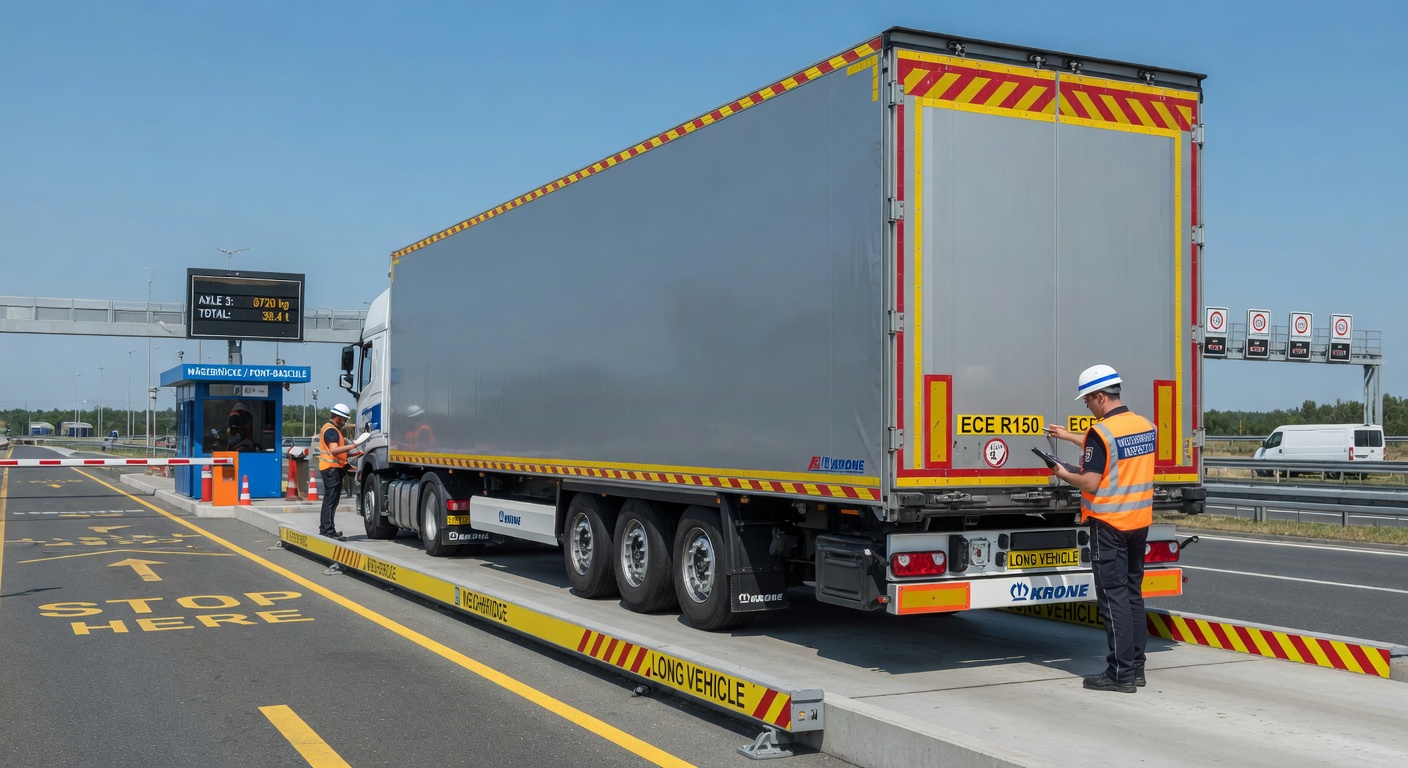
Frequently asked
Requirements apply at registration and can vary by vehicle age and country. Confirm transition dates with your inspection authority.
Dimensions refer to the vehicle or body being marked. Tractor units are generally not required to be marked.